
What’s So Special About Photo to Anime?
It is very satisfying to see a normal photograph turned into something that looks like it could have been in a Studio Ghibli movie. A lot of people have been convert image to anime for a long time, but doing it today – with much more emphasis on emotion and creativity – is a different animal. It is not a filter. It is not a party trick. It is an artistic retelling of a moment in your past retold with brushstrokes, cel shading and those eyes that are only possible in anime.
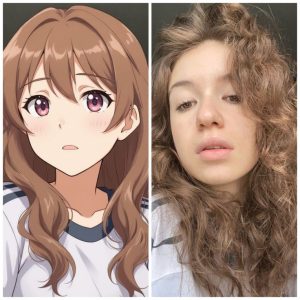
Remember your favourite photo. Perhaps a sort of an action photo from a family vacation, a bit out of focus, someone laughing. Imagine how much better it could be with watercolor backgrounds, ink contours, all bathed in the late afternoon sun of a Japanese village. That’s where good anime art conversion kicks in – to bridge the gap.
The Difference Between Filtering and Art
The truth of the matter is that most apps that claim to give you anime look like your photo had the flu and got anime. The proportions are off. The shading is muddy. The eyes look like they’re from a different person’s face. This is the difference between a filter and hand-crafted anime art.
Conversion work is about first understanding what the photo is about – the lighting, the pose, the mood. A smiling, happy child at a birthday party should not be filtered in the same way as a misty, contemplative mountain scene. The style, the colours, the line weight – all this should reflect the story the photo tells. When this happens, it doesn’t just look like anime. It looks like something you have seen in your favourite book.
There’s also the issue of what to include and what to change. Good artists don’t copy a photo. They interpret it. The slightly strange posture of the hand in the photo will be reinterpreted as a more elegant pose in the anime version. The distractions of a living room scene might become a cozy and minimalist interior that draws your attention to where it’s supposed to be. It’s this type of curatorial discernment that makes for good conversion work, rather than mindless pasting.
What Makes a Scene “Cute”
Anime has a rich history of visually speaking to the heart. It is no coincidence that people are more readily moved by animated film than by real life – stylization gives license. When faces are slightly more caricatured, emotions are easily seen. When the tones are less bright or saturated, mood is palpable. The style of anime is designed to evoke emotion, and this is why it’s so effective for storytelling.
Look at a photograph of your grandparents on the porch. The original photo is reality – lines, plastic chairs, the sun is over-exposed. But translated into anime, the same scene could show the sun shining through the trees, expressions that convey love rather than fatigue, an environment that is felt more than seen. The story does not change. The feeling intensifies.
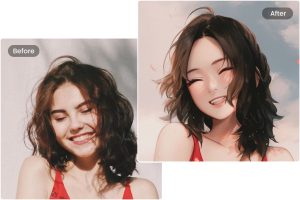
This is the magic of the conversion. It is not about making things look good. It is about removing all the photographic distractions – the incidental shadows, the ugly angles, the distracting backgrounds – and putting intention in its place. There is a purpose to everything that is in a good anime shot. When you apply that same process to your photo, your subject – the real star of the moment – gets the attention it deserves.
Wedding photos work this way. Baby photos work this way. Even photos of badly cropped family reunions, if converted correctly, are photographs that someone will hang up in their house and look at for years. Anime is a timeless format. Photos date themselves. Good anime art stands the test of time.
The Style of Your Image
There are different styles of anime, and they should not be used interchangeably, as this results in mediocre artwork. There is a range of styles from the gentle and painterly to the stark and high-contrast. You don’t draw a child’s portrait in the same way you would a dramatic scene or a couple’s portrait.
Soft shading and more diffuse outlines work well for portraits. They maintain warmth while adding no drama that didn’t exist at the time the photo was taken. But a photo of a stormy day, or on top of a mountain, might be enhanced by stronger outlines and a stronger use of colours – something that matches the dramatic reality of the original scene.
How the backgrounds are handled is important too. Some approaches feature painterly, impressionistic backgrounds that imply a location. Others are more descriptive, almost architectural backgrounds that ground the scene. This gets really tricky when you get it wrong and a lovely model of a character can look like they were glued into a film. When you get it right, the entire image feels like a single, cohesive illustration.
This is where special requests come into play. A request for a particular colour temperature, a decade of anime art style, a scene from a favourite movie or television show – these are all examples of the types of details that take conversion from good to great. The more detail you can provide about how you want the final result to look, the closer it will be to that vision.
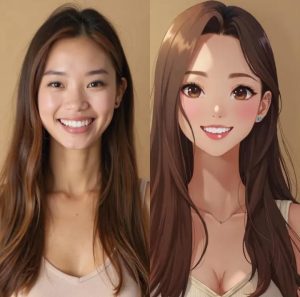
It is worth treating your source photos with some care before sending them for conversion. Good lighting in the original makes interpretation easier. Distinctive facial expressions help give artists points of reference. Complicated backgrounds or dark backgrounds are harder to work with and thus take more artistic license, which is a plus (or minus) depending on your desires.
Ultimately, the strength of anime art conversion is to take a dead moment and return it to life. Photographs capture. Anime art tells. And sometimes the story that should be told in a moment is better told with ink and pigment than by pixels and light.