
The New Browser-Based Creativity
There’s a certain creative itch that comes when you have an idea and the tools aren’t good enough. You have an idea of what your character will look like. You can pitch them to a casting director and describe them with all the detail they could wish for. But then you click on an online browser-based character creator and start scrolling through menus of options – hair number 7 of 12, eyeshape B, outfit preset 4 – and by the time you’ve clicked on the third menu, your imagined character is starting to feel like a watered-down version. The compromise used to be the price of using an anime character maker online. AI anime art has shifted that balance, and the creative freedom on the other side of this shift is worth considering.
This is not a case of old tools out, new tools in. Online character makers solved a problem, and still have their place. But AI has broadened the possibilities of online character creation – and it’s more than just an added function.
What Was Wrong with Old Online Makers
The design of most online anime character makers based on web browsers had the same basic format: a limited set of options, divided into categories, selected to create a character. You didn’t describe what you wanted. You chose from what it offered. That’s fine if what you want to do is in there. It doesn’t work if your character is somewhere in between A & B, which is most of the time if you have a particular creative vision.
The constraint isn’t the laziness of coders. It’s difficult to develop a modular character system that displays properly in the browser. The components have to function together visually, the proportions have to work across different combinations, and the overall art style mustn’t change no matter what your character looks like. Those constraints mean that the number of options is limited. The ceiling is not laziness, it’s architecture. But a ceiling is a ceiling and artists know where it is.
AI anime art does away with the architecture. There’s no library to select from. There’s no preset that’s visually compatible with another preset. You say what you want to make and the model makes it, then it’s put together on the fly rather than put together from parts. That’s a key difference that eliminates the limit. That doesn’t mean it’s not hard work – prompt generation is a skill – but it does mean the constraint is your ability to describe something, not the tool’s ability to hold it.
The switch from selection to description
People don’t realise how much this change from choosing to describing alters the creative process. Selecting is passive in a certain way – you’re looking at what’s on the menu, waiting for your favorite character. Description is active. You’re creating something out of words, which means knowing what you want before you describe it. That sounds like a curse but it’s often a blessing.
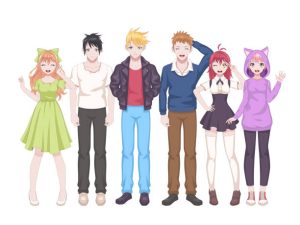
Consider how you describe a character rather than select one. You have to consider color combinations rather than individual pieces. You have to think about the mood of a scene or situation – would this character dress formally or informally, would they have an open or closed expression? You have to verbalise things about them that you may have felt but not had words for. The articulation process doesn’t just lead to better depictions. It creates a better-understood character, which will inform all of the subsequent creative choices you make about them.
Being Online Is More Than You Think
Let’s be clear: the “online” in anime character maker online is no small matter. It’s the access point. Not everyone has a super computer on which to run graphic design software. Not everyone can afford commercial illustration packages and subscriptions to desktop software. The web makes it possible for a student with an old laptop, a writer who doesn’t know design, a hobbyist who has to share a computer, to create something without up-front cost. AI anime art tools that run in a browser take that access to a new creative threshold than was accessible before.
This is important for participation in visual creative activities. The tools available influence the creative ecology that’s produced. The more accessible better tools are, the more voices that are heard in a creative space, and the more interesting and compelling it becomes for everyone.
Iteration and Velocity as Creative Enablers
A less visible feature of AI-generated characters is the speed of iteration. Commissioned work is measured in days or weeks. Even good self-illustration in digital tools takes hours per image. AI, particularly using a web interface, takes seconds. It might seem a time-savings feature, but it’s more of a creative tool, an enabler.
If iteration is quick, you’re more creative. You experiment with the version of the character that seems slightly off because it’s so cheap to do so. Sometimes the different version is the right one – the odd proportion or expression or combination of colours that you wouldn’t have thought to specify but that the model produces anyway and that turns out to be perfect. Such accidents are only possible if you’re fast enough to bump into them. Slow iteration guarantees you’re not wasting your time but it also guarantees you’re not going to find anything.
When the Character finally looks right
People who’ve done it talk about a point in character development in much the same way. You’ve been iterating, tweaking, starting over and starting again, and you know you’re close but not quite there. And then you get a draft back and it works. The expression is right. The pose is reflective of who you’ve been writing. The colors match the character and not your usual choices. You see it and you think “that’s them” – and you know this like it’s tactile.
That’s a big moment for the creative process. It’s the moment you know them, and not just in an abstract sense. From then on, what you write about them is grounded differently. Dialogue sounds more like them. Descriptions of characters are more detailed. The image becomes a focal point for the project. Doing so via an online AI anime art generator, in a web browser, without software and without expert assistance – that’s the democratization of access that transforms creative practice for those who were formerly excluded from visual creative work. The potential was always there. Now it’s actually available.